For charity run organizers, finish line awards are not just post-race consumables. They are core marketing assets. These tangible rewards drive early registration, validate participant fundraising efforts, and extend overall event visibility through enthusiastic social sharing. However, you often face a very difficult balancing act. On one hand, you want a highly memorable, completely unique design. On the other hand, you must operate within strict non-profit budget constraints and immovable event dates.
A poorly planned order can lead to unexpected rush fees or delayed shipments. This guide breaks down high-impact design ideas, essential material selection criteria, straightforward budget management frameworks, and realistic production timelines. You will learn exactly how to evaluate different suppliers, avoid common manufacturing pitfalls, and execute a flawless, stress-free rollout on race day.
Key Takeaways
Charity medals must balance emotional resonance (cause representation) with visual appeal to maximize social media ROI.
Interactive designs (spinners, puzzles) and functional features significantly increase post-race retention.
Budget is heavily dictated by material choice—zinc alloy supports complex 3D designs, while iron offers scalability for high-volume, budget-conscious events.
A reliable rollout requires understanding the "Budget Impact Matrix" and adhering to a strict 6-8 week supply chain timeline to mitigate delivery risks.
Why Custom Race Medals Are a Critical Investment for Charity Events
Participant Motivation and Fundraising
Charity events rely heavily on participant enthusiasm. Runners often need an extra push to meet specific fundraising minimums. Offering premium custom race medals serves as a powerful tangible incentive. When organizers announce a unique, beautifully crafted design months in advance, registrations naturally spike. You can even create tiered awards. For instance, participants who raise over $500 might receive a larger, distinct variation of the main award. This strategy directly fuels your primary fundraising goals.
Post-Event Marketing and Branding
We live in a highly visual, digital-first world. A striking finish line award creates a massive "social media multiplier" effect. Runners love to celebrate their achievements online. They post selfies, tag the charity, and share their finishing times. If your design looks stunning, runners are far more likely to share it across Instagram or Facebook. They also display these items on their office desks or home walls. This ongoing visibility creates valuable secondary exposure for your non-profit cause and your corporate sponsors long after race day concludes.
Differentiation in a Crowded Market
Runners have dozens of weekend events to choose from. Generic, off-the-shelf sports medals simply do not capture attention anymore. When runners compare a local 5K using stock inserts against a charity run offering a fully bespoke, 3D-sculpted design, they almost always choose the latter. Unique, thematic designs act as a primary deciding factor. To stand out, you must treat your award as a key brand differentiator.
Best Practice: Always reveal your design early in your marketing campaign. Post high-quality 3D digital renderings on your registration page to build excitement and drive early sign-ups.
High-Impact Design Ideas to Boost Event Memorability
Meaningful Shapes and Thematic Symbolism
You no longer have to settle for standard circular shapes. Modern manufacturing allows you to create completely custom silhouettes. Use shapes deeply connected to your specific cause. For example, health charities can use anatomical heart cut-outs. Cancer awareness events often utilize looping ribbon silhouettes. Animal shelters might design awards shaped like paw prints. These thematic symbols create instant emotional resonance. They remind the runner exactly why they participated and who they helped.
Puzzle Medals for Multi-Year Retention or Team Relays
Event retention is a major metric for any race director. Puzzle designs offer a brilliant solution to keep runners coming back. You can design interlocking pieces across a three-year event series. When a runner completes all three years, the pieces snap together to form one massive, cohesive display. You can also use this concept for team relays. If four people run a relay, each member receives a quarter of the puzzle. They must combine their pieces at the finish line to complete the picture. This encourages collaborative team fundraising and strong group participation.
Interactive and Functional Elements
Static designs are beautiful, but interactive designs are unforgettable. You can incorporate spinning central components to increase tactile engagement. Runners love moving parts. Beyond spinners, consider integrating functional elements. You might add a hidden bottle opener to the backplate. You could also include strong magnetic backings, allowing runners to stick their award directly onto a refrigerator. Functional features ensure the item remains useful and highly visible in daily life.
Vibrant Enamel and Glow-in-the-Dark Finishes
Color is crucial for brand consistency. You can use soft or hard enamel to match your exact charity brand colors perfectly. Suppliers use Pantone matching systems to guarantee brand accuracy. Additionally, you can deploy luminescent paints. A premium night-run marathon medal often uses glow-in-the-dark enamel to maximize visual impact in low light. This finish is perfect for Halloween runs, midnight charity walks, or neon-themed races.
Common Mistake: Do not overcrowd your design. Adding too many colors, text blocks, and moving parts simultaneously can make the final product look cluttered and cheap. Focus on one or two standout features.
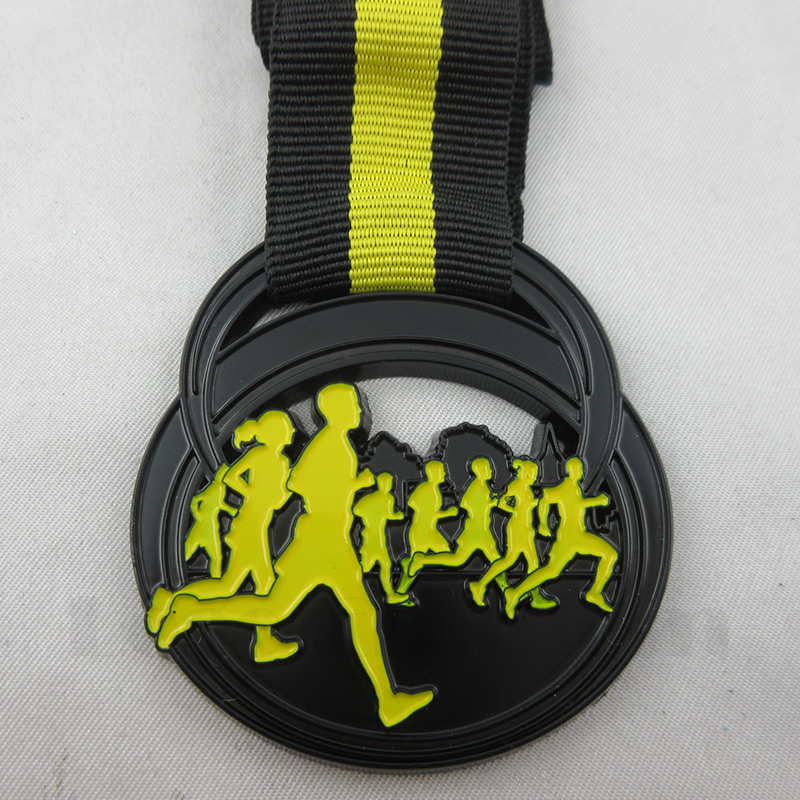
Evaluating Materials: Durability, Aesthetics, and Scalability
Zinc Alloy vs. Iron (The Metal Medal Standard)
Choosing the right base material forms the foundation of your entire project. Zinc alloy stands as the industry standard for premium events. It requires a liquid casting process. This means molten zinc is injected into a steel mold. It is best for complex 3D relief, multi-layered designs, and intricate interior cut-outs. Zinc alloy carries a higher upfront mold cost, but it provides a vastly superior, highly detailed finish. It represents the pinnacle of the modern metal medal.
On the other hand, iron offers a highly pragmatic choice for massive, high-volume charity runs. Iron is stamped rather than cast. It feels noticeably heavier, giving a strong perception of value. It is highly cost-effective at scale. However, iron is generally limited to simpler 2D stamping and standard enamel fills. You cannot easily achieve deep 3D sculpting or complex cut-outs with iron.
Wood and Acrylic (The Eco-Modern Alternatives)
Many charities now prioritize environmental sustainability. Wood offers an ideal solution for eco-conscious causes or rugged trail runs. Laser-engraved wood projects warmth, rustic charm, and strong environmental stewardship. Alternatively, acrylic provides a highly modern aesthetic. Transparent or hybrid acrylic-metal combinations offer a sleek, lightweight, and floating visual effect. Acrylic generally comes at a highly competitive price point per unit, making it excellent for tight budgets.
| | | Material Comparison Chart for Race Organizers |
Material Option | Best Use Case | Design Capabilities | Budget Impact |
Zinc Alloy | Premium runs, anniversaries | High 3D relief, intricate cut-outs, multi-layers | Higher base cost, higher mold fees |
Iron (Stamped) | High-volume 5K/10K charity runs | Standard 2D designs, bold enamel colors | Low base cost, excellent at large scale |
Wood | Trail runs, eco-charities | Laser engraving, rustic/natural finish | Medium cost, highly sustainable |
Acrylic | Modern fun runs, youth events | Transparent layering, full-color UV printing | Very low cost, lightweight |
The Budget Control Matrix for Event Organizers
Managing non-profit funds requires strict discipline. Race directors must understand exactly which choices inflate their costs. We can break these variables down into a clear Budget Control Matrix.
High Budget Impact Factors:
Your baseline material choice drastically changes the invoice. Solid brass or complex zinc alloy will always cost more than stamped iron. High-complexity tooling acts as another major factor. Features like 3D sculpting, hinged doors, or moving parts require expensive, specialized molds. Finally, shipping methods represent a massive variable. Expedited air-freight shipping can easily increase your total invoice by 30% to 50% compared to standard sea freight.
Medium Budget Impact Factors:
Overall dimensional size and thickness naturally dictate raw material usage. A 3-inch size is standard; moving to a massive 4-inch or 5-inch size pushes costs into the medium-impact tier. Minimum order quantities (MOQ) also affect unit pricing. Ordering 100 units carries a much higher per-unit cost than ordering 1,000 units. Specialized surface finishes, such as dual-plating (gold and silver together) or antique weathering, also marginally increase your spending.
Low Budget Impact Factors (Easy Wins):
Some upgrades add massive perceived value with minimal financial impact. Custom full-color sublimated neck ribbons cost pennies per unit but dramatically improve the overall look. Personalized laser engraving on the backplate is another highly affordable add-on. You can easily incorporate your sponsor logos onto the ribbon without blowing your budget.
Best Practice: If your budget is tight, shrink the physical dimensions slightly and opt for a standard 2D iron base. Then, elevate the design using a vibrant, full-color dye-sublimated ribbon. Runners notice a beautiful ribbon just as much as the metal itself.
Implementation Realities: Supply Chain and Timelines
Standard Production Phasing
You cannot rush custom manufacturing without absorbing immense financial penalties. Setting realistic expectations is vital for a smooth event. We recommend breaking down the typical timeline to understand exactly where your time goes.
Design and Proofing (1–3 days): You submit your charity logo, rough sketches, and thematic concepts. The manufacturer creates a formal 2D digital proof outlining colors, metal raised areas, and cut-outs. You review and approve this artwork.
Mold Creation and Sampling (7–10 days): The factory machines a custom steel mold based on your approved artwork. They produce a small physical batch to verify quality, paint accuracy, and structural integrity.
Mass Production (15–20 days): Once you approve the physical sample (often via high-resolution photos), full mass production begins. This phase includes casting, polishing, enamel filling, baking, ribbon attachment, and individual poly-bagging.
Shipping Logistics and Risk Mitigation
Shipping often ruins poorly planned events. You must understand the harsh contrast between standard sea freight and expedited air freight. Sea freight is highly cost-effective and perfect for non-profit budgets. However, it requires 30 to 40 days of transit time. Port congestion or customs holds can easily add an extra week. Air freight is incredibly fast, taking only 5 to 7 days to reach your door. Yet, air freight is prohibitively expensive due to the sheer weight of metal shipments.
Best Practice: Initiate the vendor selection and design brief 8 to 10 weeks prior to race day. This generous window allows you to utilize cheap sea freight. It completely absorbs any potential customs delays or unexpected sampling revisions without ever risking your non-negotiable event date.
Conclusion
Successfully planning charity run awards requires a strategic approach. You must align your design complexity with your charity's core brand identity to maximize emotional resonance. Select your materials based on your participant volume and available budget, utilizing the cost-effectiveness of iron for massive crowds or the premium feel of zinc for exclusive milestones. Finally, you must strictly manage the 8-week production timeline to avoid crippling expedited shipping fees.
Thoughtful execution transforms a simple piece of metal into a powerful marketing tool. Runners will proudly wear your cause, share your mission online, and return to your starting line year after year. Call to Action: Encourage your race directors to request a material sample pack today. Alternatively, submit your event logo for a preliminary 2D design proof to quickly assess a new supplier's capability and responsiveness.
FAQ
Q: What is the standard Minimum Order Quantity (MOQ) for custom race medals?
A: The standard Minimum Order Quantity (MOQ) is typically 100 units for custom metal molds. However, unit economics improve drastically as your volume increases. You will see significant price drops at the 500-unit and 1,000-unit tiers because the initial mold fees are spread across a much larger batch.
Q: How do we ensure the medal ribbon matches our charity's branding?
A: Specify dye-sublimated (heat-transferred) ribbons when requesting your quote. This advanced printing method allows for exact Pantone color matching. It also enables high-resolution, full-color sponsor logo printing along the entire fabric length at virtually no significant extra cost.
Q: What happens if our final participant count fluctuates close to race day?
A: The standard industry practice is ordering a 10-15% buffer above your projected registrations. Late-stage rush orders for custom metal molds are either prohibitively expensive or physically impossible due to rigid manufacturing lead times. Buying a slight surplus protects your event experience entirely.


